Tool
Ragebait Lens
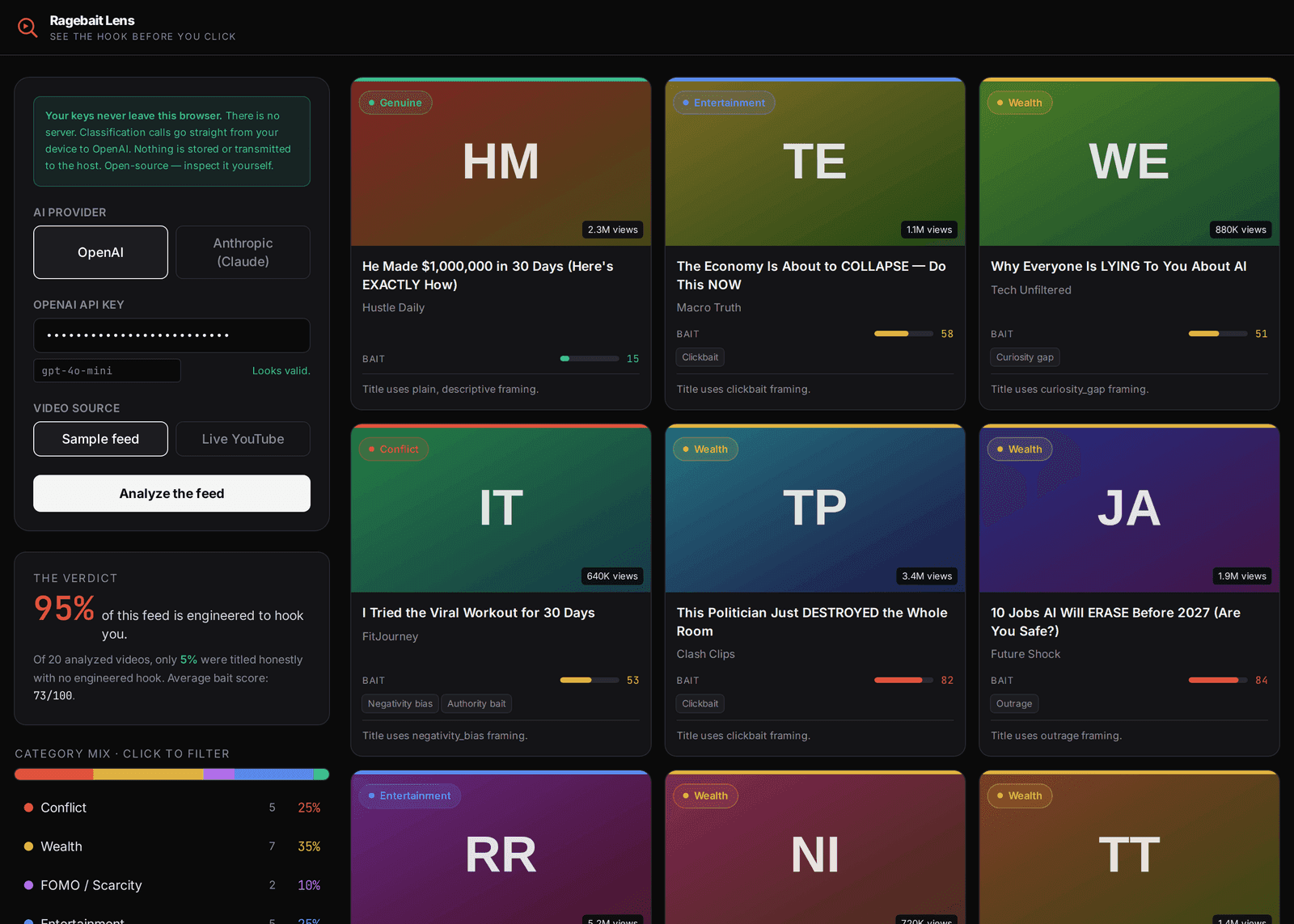
See the hook before you click. An open-source mirror for your YouTube feed.It reads the title text of real trending videos, sorts each into the psychological category it’s engineered to exploit, and shows you the math on how little of your feed is actually honest.
How it works
It names the move, then shows the math.
Pick a source — the built-in sample, today’s trending videos for your region, a channel you actually watch, a playlist, or your own subscriptions. Ragebait Lens reads the title and channel text only. It never watches the video.
Each title is sorted into exactly one of five categories — the psychological lever it pulls. It also gets a 0–100 bait score and a one-sentence rationale that points at the specific words doing the work, so the verdict is auditable rather than a black box.
Then it aggregates: what share of your feed is Conflict, Wealth, FOMO, Entertainment — and how thin the Genuine slice really is. That ratio is the whole point.
The taxonomy
Five categories. Every video lands in exactly one.
Each card links to its full entry in the glossary. The sub-tags below are the mechanisms that can layer into any title.
Sub-tags — the layered mechanisms
What we don’t see
There is no server. Ragebait Lens is a static, single-page app, so your AI key and your YouTube key never leave your browser — classification requests go straight from your device to OpenAI or Anthropic. That is the only design in which “zero-knowledge on the host’s part” is literally true.
The model reads title and channel text only. It never watches the video, and it’s instructed not to invent content — that is what keeps the report grounded rather than hallucinated. When you share a verdict, the exported image carries numbers only: no titles, no channels, no feed.
Don’t trust the claim — read the code. src/classify.ts is where the whole classification happens.
The math
Why “Genuine” is almost always empty.
The Genuine category is kept even though it almost never fills up. That’s the punchline. Watching it sit at two or three percent while Conflict, Wealth, and FOMO split the rest is the entire point of the tool: the algorithm doesn’t reward honesty, it rewards the hook.
Honestly-titled videos stay invisible unless someone goes looking for them on purpose. The Lens makes that ratio visible so you can feel the shape of the feed, not just scroll inside it.
Open source
Auditable by design.
Ragebait Lens is MIT-licensed and fully open. The classification prompt, the taxonomy, and the privacy claims are all in the open for you to check — the tool only earns the trust it asks for if you can read exactly what it does.
The briefing
The Lens shows the feed. The briefing explains it.
Twice a week, one pattern named plainly — the mechanisms behind the hooks Ragebait Lens surfaces. Free, no tracking, one click to leave.